
Treatments and surgery
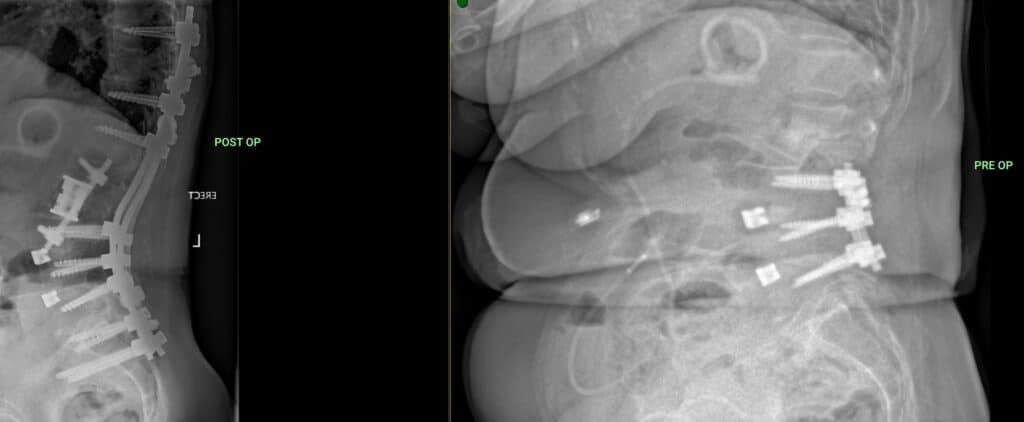
Spinal revision surgery.
Revision spinal surgery refers to the need for a repeat surgery on your back because pain has persisted after the original surgery. It is one of the treatments for failed back surgery syndrome.

Overview
What is revision spinal surgery?
Revision spinal surgery may be considered if you have developed complications after the first surgery, or if surgery does not seem to have relieved your symptoms.
It can be very disheartening to have gone through one operation, realise that it has not given you a new lease of life, and then be faced with another surgery. Understandably, you want to be sure that a second operation will deliver.
Why surgery can fail
The language of failure is not helpful here.
It is undeniably frustrating to need revision surgery. Surgeons always try to learn from these situations — but it rarely means anyone was to blame. Spinal surgery may fail because of:
Adjacent segment disease
The most common reason. The underlying degenerative condition has progressed and the levels next to your previous surgery are now affected — see adjacent segment disease.
Overall spinal balance
Overall spinal balance needs to be assessed as some surgeries can create deformity if not performed correctly and this can create new problems even if the fusion healed.
Your overall health
Smoking affects your body ability to heal bone. Underlying conditions such as diabetes, peripheral artery disease, depression or obesity can complicate your recovery.
Bone health is critical as screw fixation relies on healthy strong bone and if there has been a fracture or loosening of screw fixation then this can result in new or worsening symptoms.
Subsequent complications
A herniated disc, vertebrae that did not grow together after a fusion, scar tissue in or around the spine, adjacent segment disease, or common complications of surgery such as infection.
Pain is complex
Sometimes no medical explanation is found.
Any surgery carries risks. The human body is complex and spinal surgery is a delicate endeavour. There can be no guarantee of success.
Pain also involves complicated processes. Sometimes surgery has achieved its aims and no medical explanation can be found for your ongoing pain. Yet your pain is real. Your body may be amplifying pain messages due to your nervous system or psychosocial factors. Pain management techniques led by a psychologist or a pain clinic may help people with failed back surgery syndrome.
Treatment
What is the treatment for failed back surgery syndrome?
If you are in ongoing pain despite your back surgery, then we go back to the beginning.
Review and reassess
We review your case, examine you carefully and order fresh tests and scans to identify the cause of your ongoing pain. This may be a new condition that has developed since your surgery, or a continuation of your original condition.
Conservative treatment first
Our multidisciplinary team develops a plan of conservative options with fewer risks or side effects — pain management, psychological support, physiotherapy and occupational therapy.
When revision surgery is needed
If you develop serious complications needing immediate attention — incontinence, numbness, tingling, weakness, increased instability, spinal infection or cauda equina syndrome — or where conservative treatments are not helping.
Realistic expectations
A considered decision.
Revision surgery is complex and should only be performed if there is a clear understanding of what is causing the symptoms and there is a correctible problem.
Revision surgery is a big decision. It is worth getting a second opinion and asking detailed questions about the risks, benefits and alternatives, and being clear about the goals of revision surgery so you can have realistic expectations. The goal may be decompression, stabilisation or both.
Recovery
What is recovery like after revision surgery?
Recovery will be similar to your experience after your first surgery. You will be discharged into a rehabilitation program with our allied health team who will help you work on your strength, flexibility and ease of movement.
You can improve your chances of a good recovery by being as healthy as possible before the operation — lose weight if you need to, stop smoking, and ensure any underlying medical conditions are being treated appropriately.
Whether your original surgery was done here or elsewhere, we can review your history, identify the cause of your present pain, and recommend treatment options to help relieve some of your symptoms.
Living with back, neck or joint pain?
Dr David Edis and the team at Victorian Orthopaedic Spine Service will assess your symptoms, explain your diagnosis and recommend the treatment that best suits you.
Get in touch
Contact our rooms.
Our reception team will help you arrange a consultation, answer questions about your referral and let you know what to bring on the day.
Reception hours: Monday to Thursday 9am–4.30pm, Friday 9am–2pm
Response time: within 1–2 business days
Preparing for your appointment →
Referrals
A current GP or specialist referral is required.
Request a consultation
Send us your details and our reception team will be in touch. We aim to reply within 1–2 business days. Fields marked with an asterisk (*) are required.
All information is general in nature. Patients should consider their own personal circumstances and seek a second opinion. Any surgical or invasive procedure carries risks.